
The Religion of Atheism: When Unbelief Becomes Belief


It is often said that atheism is simply a lack of belief in God or gods, but in reality, the atheistic worldview requires belief as every worldview rests upon a certain number of unproved and unprovable presuppositions. Due to humanity's finite nature, we do not possess all knowledge, but rather, a tiny fraction of it, and our direct observational capability is quite limited. Therefore, we must rest a large amount of what we do know upon inferences and assumptions as evidence only goes so far.
Furthermore, what can be observed and what evidence can be collected must be interpreted, and therefore is subject to bias. As Plato once said, "Science is nothing but perception." As such, atheism, despite many indignant atheists' protestations, is not based upon science or evidence, but upon a framework of a priori beliefs. This claim may sound rather sensational, and possibly even biased coming from a theist, but it shouldn't be all that controversial considering prominent atheists themselves have stated as much.
"I do not like people saying that atheism is based on science, because it's not. It's an alien invasion of science."
-Carl Woese, Evolutionary Biologist, Atheist
"It is not that the methods and institutions of science somehow compel us to accept a material explanation of the phenomenal world, but, on the contrary, that we are forced by our a priori adherence to material causes to create an apparatus of investigation and a set of concepts that produce material explanations..."
-Richard Lewontin, Evolutionary Geneticist, Atheist
"The truth is that atheism is not simply an absence of belief in god, but also a set of alternative beliefs about the origin and nature of reality."
-Graham Lawton, Science Author, Atheist
Not Collecting Stamps
A common trope among atheists is that if atheism is a belief, then not collecting stamps is a hobby (or some variation of this theme). This attempts to dismiss the argument rather than actually engage or refute it, but pull on this thread just a little and the entire cloth unravels. Because while it is certainly true that not collecting stamps is not a hobby, if you read books about not collecting stamps, watch videos about not collecting stamps, follow the work and arguments of others who don't collect stamps, are part of organizations and groups whose existence and identity revolve around not collecting stamps, and constantly and incessantly tell others why not collecting stamps is better than collecting stamps, congratulations, you have a hobby. It's clear and demonstrable that atheists are not merely unengaged in a hobby, it's that they are simply engaged in a rather odd hobby of denigrating everyone else's.
It is true that not all who identify as atheists are fervent devotees to the ideology, and this is where terms of specificity are helpful. Because many who claim to be atheists are actually agnostics, a category which believes that the question of God is simply unknowable. This group doesn't make a definitive claim that there is no god, but rather, they take a rather indifferent and dispassionate stance on the fence. Then, within the category of atheism itself, which claims that there is no god, there is also a distinction between agnostic atheism and gnostic atheism. The former does not believe in god, but acknowledges that they do not know for certain that god does not exist, while the latter claims dogmatically that god absolutely does not exist.
So, it should be no surprise that the broader category of "nonreligious" can be broken into smaller sub-categories which have a tendency to increase with passion and zeal from agnosticism, to agnostic atheism, to gnostic atheism. Due to this inequal distribution of fervency, the gnostic atheists tend to be the loudest and most vocal, despite being a small minority (a 2023-2024 Pew Research poll found that while 29% of Americans identified as nonreligious, only 6% identified as agnostic, and 5% as atheist). So, it is true that it is possible to be in the atheist category by simply lacking belief, but it is untrue that atheism as a category simply lacks belief—it encompasses both unbelief as well as belief.
Gnostic Atheism
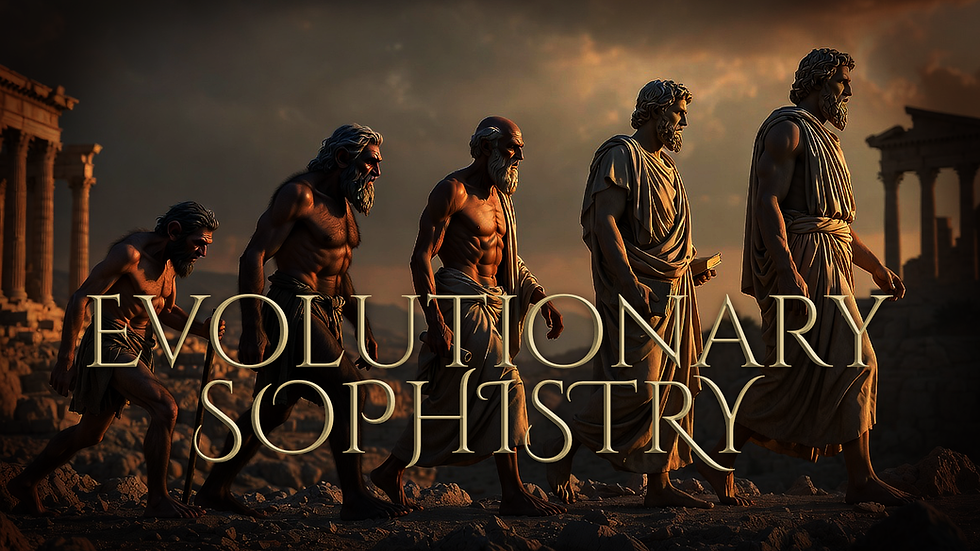
However, most atheists who fall into the gnostic category are not only quite certain of and passionate about their beliefs, but also quite adamant that their framework of belief is distinctly different from all other frameworks of belief—namely that it isn't a belief at all. This group is quite convinced, and quite active in their attempts to convince others, that atheism is the only rational, evidential, and intellectual option among the litany of superstitious, mythological, and ignorant worldviews. This is a self-reinforced mythology in and of itself as atheists promote an evolutionary narrative of the universe and humanity, then use this framework to claim that religion is an antiquated idea stemming from "bronze-age myths" while atheism is a more evolutionarily advanced concept.
This framing of the narrative is not completely without merit as historical records certainly show widespread religious acceptance among human civilizations throughout the bronze age (approximately 3300 to 1200 BC) with the first documented atheists not appearing until the iron age in both India and Greece. However, atheism is at least a 2,500 year-old idea developed simultaneously alongside other classical philosophical and theological concepts and arguments that strongly affirmed theism, and it has remained a small minority view among every human society which did not impose it by force ever since.
This hardly sounds like a beneficial evolutionary development which propagated itself throughout the species as a Darwinian advantageous trait. Some atheists may claim that simply not enough time has yet elapsed for their victory to be made complete. But the truth is, religious studies show that overall, atheism is in decline with their numbers around 138 million globally today compared to around 165 million in the 1970's, and they are projected to dwindle to 129 million by the year 2050 despite the global population increasing to nearly 10 billion at that time. So, the idea that the steady march of time is on atheism's side is yet another belief, not an evidential observation.
But the insistence on proclaiming themselves as uniquely different, and presumably better than all the theists isn't an accident, it's a defining feature and recruitment tool for self-assured atheists. This tendency of belief in intellectual superiority has produced the stereotype of the smug atheist, and examples of this arrogant attitude can be found all over the internet if you haven't had the displeasure of experiencing it in person. Again, that is not to say that all atheists exhibit this pretentious behavior or mentality. In fact, some of the harshest criticism of New Atheism, led by Richard Dawkins, Christopher Hitchens, Sam Harris, and Daniel Dennett, came from fellow atheist (of the agnostic variety) and academic Michael Ruse, who lambasted their arguments as "pathetic" their movement as a "bloody disaster," and books like Dawkin's The God Delusion as so ignorant of basic philosophy and theology that it made him "ashamed to be an atheist."
Belief and Faith
However, the tendency for the atheist identity to be wrapped up in the narrative of being inherently and uniquely different than everyone else lends itself to arrogance and is intensely and fiercely defended. Fewer arguments will rile up such vehement denials than to accuse an atheist of the very unevidenced kind of thinking they claim to be free of. Assert that their worldview is based upon belief, and they will tie themselves into knots with mental gymnastics trying to argue otherwise. Take the next logical step and point out that atheism is just as much based on faith as theism and the semantics and sophistry will be unleashed on a whole new level.
This phenomenon was epitomized in a debate I once listened to between an atheist and theist where the latter was trying to walk the former through the logical steps. He took great pains to carefully point out the enormous gaps in knowledge the atheist had in order to patiently point out that the atheistic worldview was not built upon evidence, but upon faith in unproven and unprovable assumptions. The atheist of course was quite indignant that his worldview was being lumped into the same category as the theist's and eventually retorted that he didn't have faith in his conclusions, he had confidence. In one of the few truly definitive moments I have ever witnessed in such debates, the theist then calmly exposed the sophistry being employed by saying, "My opponent claims not to have faith, but confidence... Confidence, from the Latin con fide, meaning with faith."
I have personally observed this dance in my own interactions with atheists. If the discussion takes that turn and I have the time to walk them through their arguments back to the fundamental assumptions they have absolutely no evidence of, the very best responses I have received were that those leaps of logic could be justified as scientific extrapolations based on what we have observed. Therefore, those beliefs, according to the atheist, were in fact, not based on faith like religious beliefs were. However, this argument relies on a very narrow definition of faith, relegating it to a uniquely theistic or sacred context. But Merriam-Webster refutes this limited understanding by acknowledging that faith in the general sense simply means firm belief in something for which there is no proof.
Indeed, religions didn't invent the term, they simply utilized it. In the New Testament, the word usually translated as faith in English is the Greek pistis, which was widely used in secular contexts and meant to be persuaded or convinced of the truth of something. Note that to be persuaded or convinced typically requires some form of substantiation—faith is not necessarily blind. So, the atheist may be correct that their beliefs are extrapolated from actual evidence, such as the observation that variation occurs in species then acts as a foundation for the belief that all species evolved from a common ancestor, which in turn evolved from a single celled organism, which in turn came into existence spontaneously from non-living material, which in turn came into existence spontaneously from absolutely nothing at all despite zero evidence for any of those beliefs. But what they fail to realize is that this is exactly how Scripture uses the word faith—being assured of things not seen or observed by standing on the truth of what has.
So, atheists, like theists, have not only beliefs, but faith, and what's more, they also have religion.
Religion Without God
Like faith, religion is not a word or concept invented by theists, it was merely utilized by them. In the modern age it has certainly been almost exclusively associated with theism, but that was not always the case. The term came into English usage around the 13th century by way of French, which in turn borrowed it from the Latin religio. In its original usage, religio was primarily used in secular contexts, meaning conscientiousness, sense of right, moral obligation, or duty towards anything within society or culture. This could be applied to family, heads of state, country, or even oaths as well as to gods or sacred institutions. Even in modern English this ancient understanding is preserved, with Meriam-Webster also recording an interest, cause, belief, or activity that is intensely or passionately held to, and scrupulous conformity or conscientiousness as definitions of religion.
As such, despite their vehement denials, atheists—particularly of the gnostic variety—clearly and demonstrably have religious convictions. They are passionate and extremely zealous about their beliefs and often, also intensely evangelistic about them. This has been especially true of New Atheism, where Dawkins, Hitchens, and Harris became public spokesmen and apologists for the movement, selling books, holding rallies, giving speeches, and engaging in debates in order to make, galvanize, and disciple new converts. They mocked and disparaged theism, taking particular aim at Christianity, and concocted a narrative which implicitly and often even explicitly claimed intellectual superiority over all other groups of faith.
This of course was a very alluring prospect for many, who took great pride in being able to claim membership to such an elite and exclusive group. They emulated their gurus and adopted their rhetoric and tactics by mocking theists and theism at every opportunity, parroting catchy and condescending phrases and arguments ad nauseum. Former atheist David Wood who holds a Ph.D. in philosophy and is known for his scathing critiques of Islam, argues in the highly entertaining video below that New Atheism turned adherents into obnoxious and insufferable automatons who offered little more than hubris to the discussion.
But the New Atheists weren't just lamented by theists, but as Michael Ruse demonstrates, they were also an anathema to agnostic atheists who could think a bit deeper and were capable of self-reflection and evaluation. Atheists and evolutionists like Ruse could admit that their beliefs were religious, despite the gnostic atheist dogmatic narrative that "scientific" atheism was somehow the antidote to and the antithesis of religion.
"If teaching 'God exists' is teaching religion—and it is—then why is teaching 'God does not exist' not teaching religion? Obviously it is teaching religion."
"The literalists are absolutely right. Evolution is a religion. This was true of evolution in the beginning, and it is true of evolution still today."
-Michael Ruse, Philosopher of Science, Atheist
The reality is that atheism sells evangelistic and apologetic books, has its own set of religious "prophets" (they make failed predictions) who are followed, listened to, and emulated, and clearly has a zealous and fanatical base that loudly proclaims their arguments and diatribes against opposing views (though like other obnoxious views, they tend to be most vocal online due to the safety of anonymity). This should be enough evidence that atheism is obviously not just a hobby, but a religio(n). But the reality that it also forms numerous activist groups such as American Atheists and the Freedom From Religion Foundation in order to shape public opinion and policy, and organizations like the Atheist Alliance International and the Atheist Community of Austin to focus on community outreach and raise awareness of their beliefs, should settle the issue. But the fact that atheist churches have popped up around the Western world should put it beyond question. Clearly atheism is not simply a "lack of belief," it is a worldview, constructed on a set of fundamental beliefs which affect, influence, and inform an adherent's views of theology, philosophy, and science.
The Burden of Proof
The final argument an theist may attempt in order to maintain the claim that atheism is inherently different from theism as a belief system is that the burden of proof lies on those who make the claim that God or gods exist. Often the catchy phrase "Extraordinary claims require extraordinary evidence," typically attributed to Carl Sagan, is copied and pasted like a religious creed. Again, this claim is not without some merit. The burden of proof does indeed lie upon the one making the claim.
However, the claim is not extraordinary at all, for the word means going beyond what is usual, regular, or customary. Theism throughout all of human history has not been the unusual, irregular, noncustomary, or non-ordinary view—atheism has. Though humanity may have varying and competing views of who or what God is, sages, philosophers, and learned men and women throughout the ages have overwhelmingly agreed that there is a reality beyond the physical dimension of the universe. That doesn't make it true necessarily, but it certainly makes the claim utterly unextraordinary.
If Sagan meant extraordinary in the sense that God's existence goes beyond the ordinary or mundane experience, the same would also be true of the current materialist explanation of the universe. We have never witnessed the extraordinary and utterly unique event of the big bang, where it is posited that all the matter in the universe suddenly popped into existence out of nothing and from nowhere, then without an outside force, suddenly exploded and expanded, creating all of space and time. We have never witnessed non-living chemicals arrange themselves into unimaginably complex systems and become a living cell. We have never witnessed a single-celled organism become a multicellular organism. We have never witnessed asexually reproducing organisms spontaneously form male and female pairs that can sexually reproduce. We have never witnessed an organism with one body plan, morph into a completely different one (eg: a fish with fins and gills become a mammal with legs and lungs).
These extraordinary claims boggle the mind, contradict much of what we do actually know about physics, energy, information, life, and complex systems, and stretch logic and credulity to an extreme degree—so why don't atheists require extraordinary evidence for them? Instead, atheists such as Dawkins just accept them as incontrovertible facts and don't even attempt to describe the process, let alone explain it or offer extraordinary evidence for it.
The fact that life evolved out of nearly nothing, some 10 billion years after the universe evolved out of literally nothing, is a fact so staggering that I would be mad to attempt words to do it justice.
-Richard Dawkins, The Ancestor's Tale:
A Pilgrimage to the Dawn of Evolution, 2005
The second problem with the burden of proof argument is that often, no amount of evidence is ever enough to convince the skeptic. It's not that the theist cannot present any evidence, it's that the atheist so often will not accept it. Rather, they will invoke the argument from personal incredulity—a logical fallacy—to dismiss any and all evidence that challenges their position. Atheist apologist and debater Matt Dillahunty is rather famous for this tactic of demanding evidence, and then when presented with it, responding with the dismissive, "Well, I'm just not convinced!" But the fact someone is not convinced is not the same as evidence does not exist. After all, before Richard Dawkins became the torchbearer for atheism, it was Antony Flew, who in the end, converted to theism precisely because of the evidence.
"I now believe there is a God... I now think it [the evidence] does point to a creative intelligence almost entirely because of the DNA investigations... My discovery of the divine has been a pilgrimage of reason and not faith."
-Antony Flew, There is a God: How the World's
Most Notorious Atheist Changed His Mind, 2008
On the other hand, atheist academic Peter Boghossian has stated that for him to believe in the divine, he would need a grand sign like all the stars in the sky being organized to spell out the message “I am God communicating with you, believe in Me!” that every person on planet earth witnessed simultaneously in their own native language. However, even with this incredible evidence, Boghossian admits that it likely wouldn't convince him as it would only be suggestive and not definitive proof, because alternative explanations like mass delusion, simulation, or other non-divine causes would be far more believable to him. In other words, the burden of proof isn't an argument, it's an insurmountable rhetorical defense masquerading as reason.
Because the reality is, the evidence Boghossian supposedly requires actually exists. There is indeed a universal language seen in the stars and the universe above and around us that defies the materialist explanation—mathematics. As I briefly outline in the second chapter of the book, Mere Spirituality:
"Take for example, the reality of mathematics in the abstract world. These concepts, equations, numbers, and theorems exist independently of the human mind. We do not invent or imagine them, nor are they subjective to the human observer. Instead, we discover these external, independent, and objective truths. But though they are independently and universally true, they are not physical and exert no force upon the physical world, nor does the physical world exert any force upon them. Therefore, the abstract world has no material causal mechanism or explanation. Its intricacy, elegance, and precision screams of mind and intellect, and it aligns so perfectly with the physical world that it cannot be mere coincidence. Yet, it has no direct relationship to the physical world—it can only be perceived by the mental world. So, if objects in the abstract world aren’t a product of the physical world and aren’t a product of the human mental world, then where, or in what mind, do they exist?"
So, yes, atheism can absolutely be a religious belief, held and defended religiously, because the term religion is not now, nor has it ever been exclusive to theistic or sacred contexts, just as the term faith has not. Due to our finite nature, humanity must live by faith in a number of fundamental assumptions regardless of our worldview. Lacking omniscience, belief is required for us to make any claims about the nature of existence. And so, as the old adage goes, you can take man out of religion, but you cannot take religion out of man.
For the wrath of God is revealed from heaven against all ungodliness and unrighteousness of men who suppress the truth in unrighteousness, because that which is known about God is evident within them; for God made it evident to them. For since the creation of the world His invisible attributes, His eternal power and divine nature, have been clearly seen, being understood through what has been made, so that they are without excuse. For even though they knew God, they did not honor Him as God or give thanks, but they became futile in their speculations, and their foolish heart was darkened. Professing to be wise, they became fools, and exchanged the glory of the incorruptible God for an image in the form of corruptible man and of birds and four-footed animals and crawling creatures.
ROMANS 1:18-23 (NASB)


Comments